
Isle of Man

An Introduction to Isle of Man Foundations for Offshore Planning (1 of 3)

Whilst Isle of Man Trusts and Isle of Man Limited Companies have been mainstays of offshore wealth planning for decades, the relatively recent introduction of the Isle of Man Foundation in 2011 has provided advisers with a blend of features possessed by corporate entities and fiduciary vehicles, to further their clients’ objectives.

Having been the preferred choice of our Civil Law counterparts for centuries, a Foundation offers objectivity and operational structure without compromising on flexibility, where discretion is concerned.

This is the first in a three part series we have produced on Foundations, building up to a webinar hosted by experts who can help you to meet your clients’ needs. If you would like to read the other articles in this series, please see:

In this introductory article, we will discuss the rudimentary aspects of Foundations, to aid or refresh your understanding:

  • What is an Isle of Man Foundation?
  • Foundation vs Trust vs Limited Company
  • What is an Isle of Man Foundation used for?
  • Supporting the Establishment & Administration of Foundations

What is an Isle of Man Foundation?

An Isle of Man Foundation is established and regulated under the Foundations Act 2011, and registered on the Isle of Man. The Act has added the Civil Law entity to the toolbelt of advisers seeking to provide offshore services from a well-established international financial centre.

The blended approach that Foundations offer is unique, with features that make them distinct from more familiar structures such as Limited Companies or Trusts.

The next article in this series will take a dive into the technicalities of all aspects of this vehicle, but for now we have just provided a brief overview of the constituent elements that you need to be aware of:

  • Founder – The person who initially instructed the establishment and agreed the objects of the foundation.
  • Dedicators – Anyone other than the Founder that dedicates assets to the Foundation.
  • Official Documents – There are two official documents, the Foundation Instrument and the Foundation Rules, which set out the details relating to the administration of the foundation and the rights and obligations of the persons appointed under the rules.
  • Objects – Specified in the Foundation Instrument, these detail the specific purpose and objectives of the Foundation.
  • Council – Comprised of one or more members, the Council carries out the administration of the Foundation in accordance with the Official Documents.
  • Registered Agent – All Foundations must have a Registered Agent licensed by the Isle of Man Financial Services Authority. You can find more information on Isle of Man Registered Agents here.
  • Enforcer – If an object of a foundation is to carry out a non-charitable purpose, the foundation must have an Enforcer.  This person ensures that the Council operate in line with the Official Documents and in the best interests of the Foundation.
  • Beneficiary – The party that can benefit from the Foundation.  

Foundation vs Trust vs Limited Company

The table below compares and contrasts the features of Isle of Man Foundations, Trusts, and Limited Companies and may be helpful to determine the most appropriate vehicle to achieve the desired objectives.
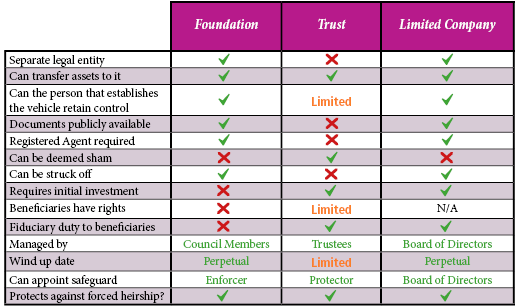
Whilst Foundations cannot conduct commercial trade directly, other than trade relating to the Objects, it can hold subsidiary companies which can in turn be used for commercial transactions.

As you can see from the table, both a Foundation and a Trust can be used in very similar circumstances, to benefit successive generations or charitable initiatives. The main differences relate to the flexibility in making operational changes (e.g. appointment and removal of Council Members / Trustees and/or editing the constitutional documents), liability of the managers (i.e. legal action is against the Foundation rather than its Council Members), perpetuity and winding up – each offering discretion or choice in certain areas, which can make it better suited to the client’s needs.

Ultimately, a Foundation provides a living structure that can be reactive and adaptable to changing needs, where provided for, in the Official Documents. Something that can be more limiting when using a Trust structure.

Of course, Foundations can also be used in conjunction with trusts to provide some of the benefits of a trust combined with those of a corporate entity – e.g. diversified interests, to act as trustee and to provide additional oversight and transparency; which might make institutional transactions more attractive.

What is an Isle of Man Foundation used for?

A Foundation holds and owns assets, typically provided for specific purpose; for example, to benefit family members or philanthropic endeavours. With this in mind, uses of Isle of Man Foundations can include:

  • A familiar alternative to trusts for clients from Civil Law jurisdictions;
  • A legal entity for succession planning or philanthropic pursuits;
  • A wealth planning vehicle to hold assets (e.g. private company shares, yachts, aircraft);
  • Use in conjunction with a Trust to provide additional structure and oversight;

Supporting the Establishment and Administration of Foundations

At Dixcart, we offer a full suite of offshore services to advisers and their clients when considering the establishment of an Isle of Man Foundation. Our in-house experts are professionally qualified, with a wealth of experience; this means we are well placed to support and take responsibility for different roles, including acting as Registered Agent, Council Member or Enforcer as well as providing specialist advice, where appropriate. 

From pre-application planning and advice, to the day-to-day administration of the Foundation, we can support your goals at every stage.

Get in touch

If you require further information regarding Isle of Man Foundations, their establishment or management, please feel free to get in touch with Steve Doyle at Dixcart: advice.iom@dixcart.com

Alternatively, you can connect with Steve on LinkedIn

Dixcart Management (IOM) Limited is licensed by the Isle of Man Financial Services Authority.

To continue reading this article, register to receive Dixcart newsletters.
I agree with the Privacy Notice.

Trusts and Foundations: A Q&A

A Changing World

Particularly, in light of the recent Covid-19 pandemic, many individuals are considering how they can best protect their family health and their family wealth, across future generations.

Many have already set up family offices and use Trusts and/or Foundations as wealth preservation vehicles within these.

This Article is intended for those considering taking such steps.

Dixcart has offer 45 year of experience in helping establish Trust and Foundation vehicles and providing Trustee services. We are licensed to offer these services across the five jurisdictions of; Cyprus, Guernsey, Isle of Man, Malta and Switzerland.

What will be most appropriate, depends on your circumstances and we strongly advice that you take professional advice: advice@dixcart.com.

Questions and Answers

What is the History in Relation to each Vehicle?

Trusts have been used in common law countries for many hundreds of years, for a variety of reasons. With the development of international business, international tax and estate planners were quick to realise the benefits of using offshore trusts in mitigating tax liabilities and assisting in the flow of family wealth through the generations.

Historically, clients from civil law countries have been more familiar with the concept of the Foundation. However, now they are becoming increasingly aware of the benefits of Trusts, and it is the same in terms of common law countries and Foundations.  

How Can a Trust or Foundation Help Preserve Wealth Across Future Generations?

It is a legal arrangement where the ownership of the ‘Settlor’s’ assets (such as property, shares or cash) is transferred to the ‘Trustee’ (usually a small group of people or a trust company) to manage and use to benefit the ‘Beneficiaries’, a third person, or group of people, under the terms of a Trust Deed.

A Foundation creates a separate legal entity with its own legal personality, distinct from the ‘Founder(s)’, who transfers assets into the Foundation, the ‘Council’ manage the Foundation and the ‘Beneficiaries’, benefit from it.

Charitable foundations are the most common and the majority are set up to exist in perpetuity. This means that control over the foundation and its assets can be passed to countless generations of the family.

Are Trusts and Foundations ‘Private’?

In most jurisdictions, no requirements currently exist to register a Trust or for any document or information in connection with the Trust to be placed in the public domain, and the arrangement may therefore be kept completely private.

Limited information in relation to Foundations will be publicly available, but there is currently no requirement that the identity of the Founder, Beneficiaries or purposes of a Foundation should be made publicly available.

Trusts and Foundations can, therefore, both be private arrangements under current rules.

What are the Key Differences Between a Trust and a Foundation?

A number of the key differences are outlined below:

  • A Trust is not a legal entity; a Foundation is a registered legal entity.
  • The ownership of the assets in a trust rests with the Trustee whilst the Foundation owns the property concerned directly.
  • by its Charter and Articles or regulations.
  • Potentially, a Foundation provides more certainty than a Trust and it is less likely to be treated as a potential ‘sham’, particularly in civil law jurisdictions.
  • information and they generally do not have any equitable or other forms of ownership of foundation assets.
  • Trusts are intrinsically more flexible than Foundations.
  • A Trust can be used for commercial purposes but Foundations, except under limited circumstances, cannot be so used.

What are the main Reasons for having a Trust or a Foundation, in addition to Wealth Preservation?

In addition to the preservation of wealth, selected distribution of assets and favourable tax treatment, Trusts and Foundations are used to achieve the following:

  • Circumvention of forced heirship laws
  • Asset protection
  • Confidentiality
  • Continuity on death
  • Philanthropy

Dixcart Offices Regulated to Provide Private Client Services:

Dixcart has five offices with extensive expertise in providing Private Client Services, including the provision of Trusts and Foundations:

  • Cyprus: Dixcart Management (Cyprus) Limited is regulated and holds a full fiduciary licence under the Cyprus Securities and Exchange Commission.

Email: advice.cyprus@dixcart.com.

  • Guernsey: Dixcart Trust Corporation Limited is regulated and holds a full fiduciary licence under the Guernsey Financial Services Commission. Dixcart Trust Corporation Limited is a member of the Guernsey Association of Trustees. Email: advice.guernsey@dixcart.com.
  • Isle of Man: Dixcart Management (IOM) Limited holds a full fiduciary licence and is regulated by the Isle of Man Financial Services Authority. Dixcart Management (IOM) Limited is a member of the Association of Corporate Service Providers.

Email: advice.iom@dixcart.com.

  • Malta: Elise Trustees Limited Dixcart House is regulated and holds a full fiduciary licence under the Malta Financial Services Authority.

Email: advice.malta@dixcart.com.

  • Switzerland: Dixcart Trustees (Switzerland) SA is a certified member of Swiss Association of Trust Companies (SATC). Dixcart Trustees (Switzerland) SA is affiliated to “Association Romande des Intermédiaires Financiers (ARIF)” a Swiss self-regulatory organization (SRO) officially recognised by Swiss Federal Financial Market Supervisory Authority (FINMA).

Email: advice@switzerland.com.

Summary and Further Information

Trusts and Foundations can be used to achieve many objectives. The choice of jurisdiction for a Trust and/or Foundation is important and is generally governed by the specific circumstances of each family/family office.

If you would like additional information, please speak to your usual Dixcart contact,  one of the Dixcart offices above, or email: advice@dixcart.com.

To continue reading this article, register to receive Dixcart newsletters.
I agree with the Privacy Notice.

The Benefits of Appointing a Non-Executive Director (NED)

What is a ‘NED’?

Non-Executive Directors (NEDs) can play an important role within a business. They sit on the board of a company but are not part of the executive team and can therefore bring an impartial view without the conflict of having to manage the day to day operations of the company.

NEDs can monitor the executive directors, become involved in strategic policy making and, of course, act in the interest of the company’s shareholders.

What are the Benefits of Having a NED on the Board?

  • Add an impartial view to the day to day running of the business.
  • Help ensure that the Executive Directors are operating as efficiently as possible.
  • Contribute to the strategic plan of the company.
  • Monitor the performance of the company and offer constructive ideas and solutions, if required.
  • Act in the best interest of the shareholders.
  • Add additional experience and credibility to the company board.
  • Expand the intellectual and strategic resources of the company.

What Type of Person Acts as a NED?

A Non-Executive Director is typically chosen based on their experience, reputation and understanding of the business. This individual is likely to be professionally qualified, with a strong background in corporate governance and risk. They have usually worked at a ‘C-suite’ level in at least one other previous company.

Other Legal and Regulatory Aspects to Consider

All directors, including NEDs have legal responsibilities to conduct their duties in an appropriate manner and they need to have an understanding of the requirements of the jurisdiction that they work in, as well as a reasonable knowledge of the other jurisdictions in which the company operates. If these individuals do not comply with their duties, they may be liable to civil and/or criminal proceedings and may be disqualified from acting as a director.

A NED must act in good faith and in the best interest of the company and they must not delegate their overall responsibility. Any potential conflict of interest should be fully and properly disclosed to, and approved by, the company to ensure that no conflict exists in relation to the company’s constitution.

Summary

A Non-Executive Director on the board of a company can offer a number of positive benefits. Care should always be taken to ensure that such an individual is appropriate and has the necessary experience and skill set to join the board in this capacity. The appointment of the ‘right’ NED can bring a plethora of additional attributes to the company.

Dixcart have a number of senior managers who have extensive experience acting as NEDs, across a wide variety of industry sectors.

Additional Information

If you require further information regarding Non-Executive Directors, please speak to your usual Dixcart contact or email: advice@dixcart.com.

To continue reading this article, register to receive Dixcart newsletters.
I agree with the Privacy Notice.